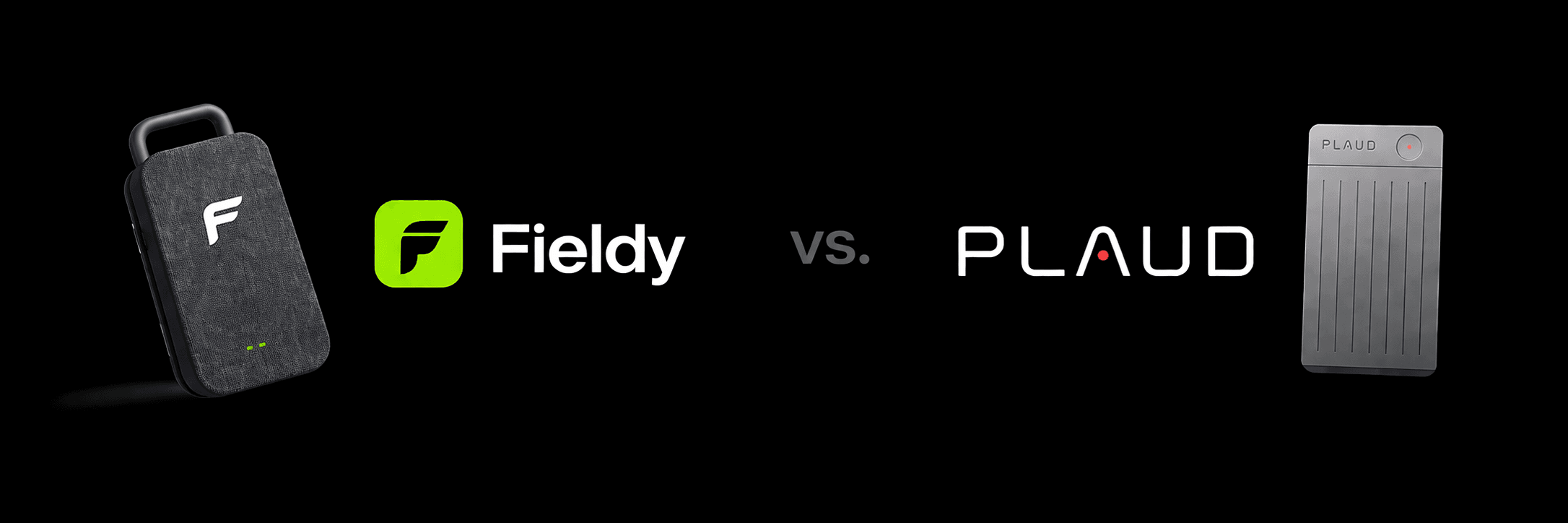
Welcome to our Fieldy vs. Plaud comparison.
We think the honest comparison is more useful than a one-sided verdict — because Fieldy and Plaud aren't really trying to solve the same problem. Buying the wrong one for your use case will leave you frustrated, no matter which one it is.
The short version: Fieldy is a personal memory device. Plaud NotePin S is a professional documentation tool. They look similar. They work very differently.
What each device is actually built for
Fieldy is designed to be always on. You clip the pendant around your neck and it records whatever is happening around you throughout the day — meetings, doctor visits, casual conversations, anything. The goal is a searchable archive of your life that you don't have to actively manage. It's closer in spirit to a life-logging device than a professional recorder.
Plaud NotePin S is designed for intentional professional capture. You decide when to record. The AI produces structured output in professional formats, and the system covers every scenario where professional conversations happen: in-person meetings via NotePin S, video calls via Plaud Desktop, and phone calls via Plaud Note. One platform, three scenarios.
That design difference shapes everything else.
Fieldy costs less. If you want to experiment with wearable AI recording at a lower entry price, it's a reasonable place to start.
But for professionals whose work spans in-person meetings, video calls, and phone calls, the value comparison shifts. Fieldy covers one meeting scenario. Plaud covers three. And when you add the 9,000-unit vs. 1.5-million-user reliability gap on top of that, the $20 hardware price difference stops being the deciding factor.
The reliability problem nobody talks about
This is the argument that matters most. So we're putting it first.
Fieldy's original architecture streamed audio directly to your phone over Bluetooth in real time, with no local backup. Fieldy addressed this in mid-2025 with a firmware update (2.2.2B) that added offline storage — the device can now hold up to 3 hours of audio locally if the Bluetooth connection drops, syncing when it reconnects.
That's a real improvement. But it comes with meaningful caveats. Devices running older hardware (firmware 1.0.8B and below) cannot install the update at all — they're stuck with the original streaming-only architecture. For users on newer hardware, the 3-hour local buffer means a short Bluetooth drop won't wipe a conversation. But a full day of meetings can exceed that limit, and once the buffer is full, the device overwrites the oldest recordings automatically. More importantly, AI processing — transcription and summaries — still requires a cloud connection. Offline mode stores raw audio only. You still can't get usable notes without syncing.
What makes it worse: users have reported that reconnecting after a drop is often not straightforward. The app frequently gets stuck in a loop, reporting the device is "already paired" or "connected to another phone," requiring resets to clear. For a device marketed as frictionless, that friction still shows up in real-world use.
By comparison, Plaud NotePin S stores everything locally on the device itself. There's no Bluetooth dependency during recording. Your phone can die, your Wi-Fi can cut out, you can walk into a dead zone — the recording keeps going. You sync to the Plaud App when you're ready. Up to 20 hours of continuous recording on a single charge.
When you're recording a client negotiation, a medical consultation, or a legal discussion, "the Bluetooth dropped" is not an acceptable explanation for why the recording is missing.
Hardware: Built for what, exactly?
Fieldy is a pendant with a single microphone. It's lightweight and wearable — that part works. But the single-mic setup and Bluetooth-dependent architecture create real limits in group settings. Users have noted that in noisy environments or in rooms with multiple speakers, transcription quality drops noticeably. And because there's no full local audio backup, a bad transcript is all you have.
There's also a durability issue that users have flagged directly. Fieldy has no water or moisture resistance. Users have reported that ordinary sweat from wearing the device against the skin is enough to cause damage, with some users reporting they went through two devices. For something you're meant to wear all day, that's a meaningful product shortcoming.
Plaud NotePin S uses dual high-fidelity microphones with AI speech enhancement, stores audio locally, and comes with four included accessories: magnetic pin, clip, lanyard, and wristband. You choose how to wear it based on your situation, and the recording doesn't depend on your phone staying connected.
When your minutes run out, what do you have?
This is a point worth understanding before you buy Fieldy.
Because Fieldy doesn't save local audio, it can only function when it's connected and processing. That means when your transcription minutes run out, the device becomes non-functional. Not reduced-functionality — completely useless. You can't even use it as a basic audio recorder.
Fieldy originally included 10 hours of free transcription per month. That has since been reduced to 2.5 hours. Users who signed up expecting the original quota were not happy about the change.
Plaud devices store audio locally whether or not you have an active subscription. Run out of transcription minutes? The recording still happens. The AI processing waits. You can add minutes when you're ready. The hardware never becomes a dead weight.
AI output: Notes for your life vs. documents for your work
Fieldy generates conversational summaries, extracts tasks, creates reminders, and lets you ask an AI questions about past conversations. For personal use — remembering what a doctor said, tracking informal commitments, reducing cognitive load throughout the day — it's genuinely useful. It's designed for daily-life recall.
Plaud Intelligence generates structured professional output. Over 10,000 templates cover the specific formats professionals actually need: SOAP notes for clinicians, sales call debriefs, legal consultation summaries, executive decision logs, consulting engagement briefs. You assign a template before or after recording, and the summary comes out formatted for that specific use case. Not a general paragraph you have to reshape. Something closer to ready-to-file.
Plaud also runs on GPT-5.2, Claude Sonnet 4.5, and Gemini 3 Pro. Transcription runs in 112 languages with speaker diarization and custom vocabulary support.
And there's Press to Highlight. Fieldy's always-on model is passive: capture everything and let AI sort it out later. With NotePin S, a short press during recording flags the current moment as high-priority context. A decision just got made. A number was committed to. You press. The AI knows what to focus on. It's a small detail that makes a real difference in professional output quality.
Coverage: Fieldy does one thing, Plaud does three
This is the clearest practical difference for anyone in knowledge work.
Fieldy captures in-person conversations only. There's no desktop app, no video call integration, no phone call recording. If half your meetings are on Zoom — which is true for most professionals — Fieldy doesn't cover them.
Plaud covers three scenarios:
In-person meetings: NotePin S, worn or clipped
Online meetings: Plaud Desktop records Zoom, Meet, and Teams, bot-free
Phone calls: Plaud Note attaches to your phone for direct call capture
All three live in the same Plaud App, with the same AI layer and the same note history. If you move between a conference room, a Zoom call, and a client phone call in a single afternoon, Plaud handles all of it. Fieldy handles one of the three.
Privacy: "Always on" has real consequences at work
Both devices are HIPAA-compliant. That covers the baseline for healthcare professionals.
But Fieldy's always-on recording model creates a legal exposure that's easy to underestimate. In most U.S. states and most countries, recording a conversation requires consent. An always-on pendant that runs throughout your workday means the device records every nearby conversation, whether those people know it or not. In a professional setting (client meetings, confidential internal discussions), this requires active legal attention every day.
Plaud NotePin S is a start/stop device. You decide when it's recording. That model is easier to manage professionally: you can tell people you're recording before you press the button, which is both legally cleaner and socially more appropriate in client-facing work.
Support when something goes wrong
Our support team is available across multiple channels — in-app, email, and community — and handles real issues every day. Every Plaud device also comes with a one-year warranty and lifetime customer support. We're a company of real people who are available when you need us.
We know that matters. Because when a recording of an important meeting fails, the first thing you need is someone to actually pick up.
Who should get Fieldy, and who should get Plaud
Get Fieldy if your primary need is personal life-logging — ambient memory assistance, ADHD support, capturing informal conversations you'd otherwise forget. Get Fieldy if you want the lowest entry price into wearable AI recording and are comfortable with a product that's still maturing. And if you want something that records passively throughout your day without you having to remember to press anything, Fieldy's always-on model is a genuine advantage over Plaud's start/stop approach.
Get Plaud NotePin S if your work includes a real mix of in-person meetings, video calls, and phone calls. If transcription accuracy in real group settings matters. If you need professional-format output, you can drop into a client file, a medical record, or a CRM without reformatting. If you cannot afford an important recording to fail.
For most professionals, that's the second profile. Fieldy has a genuine use case. For work that demands complete, reliable documentation across every professional scenario, Plaud NotePin S is the right tool.
Frequently Asked Questions
Can Fieldy be used without a subscription?
What happens if my phone disconnects during recording?
Which device is better for noisy environments or group meetings?
